The short answer
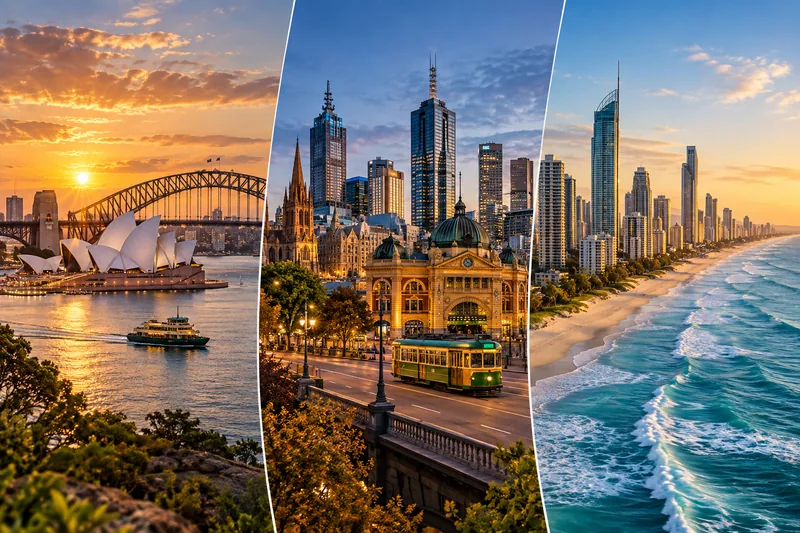
Choose the first destination before you choose the route. Start with Sydney for iconic first-time Australia and strong no-car sightseeing, Melbourne for food, culture and city character, or the Gold Coast for beaches, families and theme-park priorities.
Then ask whether the TOTAL trip length earns another flight and hotel change. Use 7 / 10 / 12 / 14 TOTAL DAYS, including travel, arrivals, departures and base changes. They are not the same as local full sightseeing days.
Around 9–10 total days is where a two-destination trip becomes much more defensible. A 14-day trip can support testing three destinations, but a longer itinerary is not automatically a better one.
In this guide
Choose the first destination
| Destination | Strongest fit | Why it works | Main trade-off |
|---|---|---|---|
| Sydney | First-time icons, harbour, mixed sightseeing, no-car trips | Strong all-round first-Australia identity | Regional extensions need real time |
| Melbourne | Food, culture, couples, neighbourhood life | Strong city depth plus regional options | The famous regional days can be long |
| Gold Coast | Families, beaches, theme parks, resort-style time | Clear family / leisure role | It is a different trip style from Sydney or Melbourne |
Sydney: the broad iconic first choice
Sydney is the easiest starting point when the trip is built around harbour icons, city sightseeing and a no-car-friendly urban experience.
Allow 4 FULL DAYS for the city core, 5–6 FULL DAYS when one extension is added, and 7 FULL DAYS for more depth. A Blue Mountains FULL DAY is an extension day, not invisible extra time.
Melbourne: choose city character and regional depth
Melbourne suits travellers who place more weight on food, culture, neighbourhoods and a different urban rhythm.
Allow 4 FULL DAYS for the city, 5–6 when one extension is added, and 7+ FULL DAYS for more depth or a Great Ocean Road experience that may use 1–2 NIGHTS.
A Great Ocean Road day is a LONG TRAVEL DAY. Phillip Island is framed as an AFTERNOON–LATE EVENING commitment. Those units should not be flattened into the same thing.
Gold Coast: choose the family / beach trip on purpose
The Gold Coast is strongest when beaches, family time and theme parks are central rather than incidental.
Consider 4–5 DAYS or 6–7 DAYS, including 1–2 theme-park DAYS and a flexible day. These Gold Coast “days” are not defined as the same unit as Sydney’s or Melbourne’s FULL DAYS, so keep them separate.
Use TOTAL trip length to test another destination
| TOTAL trip length | Route logic |
|---|---|
| 7 DAYS | Protect the first destination rather than forcing a second |
| 10 DAYS | A two-destination trip becomes realistic if the pairing is genuinely wanted |
| 12 DAYS | Two destinations can be stronger, with room for one meaningful extension |
| 14 DAYS | Three destinations can be tested, but only if the extra move is worth it |
Paired routes sit around 9–10 TOTAL DAYS, often allocating roughly 4–5 nights + 4–5 nights. At 12 days, about 5 nights each plus one extension becomes possible. At 14 days, a three-stop shape around 4 + 4 + 4–5 nights can be considered.
These are route-building allocations, not a formula that converts total days into local full days.
Keep local time units separate
Australia is large enough that a “travel day” matters. Do not count a domestic flight and hotel change as if it were an untouched local sightseeing day.
Likewise:
- FULL DAY in the Blue Mountains is an excursion unit.
- 1–2 NIGHTS on the Great Ocean Road is a stay choice.
- AFTERNOON–LATE EVENING for Phillip Island is a daypart commitment.
- Theme-park DAYS on the Gold Coast are activity allocations.
- The 7 / 10 / 12 / 14 DAYS at country level are total-trip bands.
The route becomes clearer once those units stop competing with each other.
Regional extensions compete with another city
A regional extension and a second destination draw from the same finite trip.
For example, a traveller who cares deeply about Sydney plus the Blue Mountains may get more from a deeper Sydney stay than from adding Melbourne simply because a map suggests it.
The same applies to Melbourne: Great Ocean Road or Phillip Island can be the extra experience instead of another flight.
Choose the trip that matches your priorities, not the route with the highest number of pins.
Where Brisbane fits
Brisbane is not an automatic fourth equal destination in this framework. It can work as an optional city or gateway, including around a Gold Coast trip, but it should earn its place rather than appearing by default.
Allow about 2 NIGHTS when Brisbane is included. Keep that as a night allocation, not as a new Australia-wide duration threshold.
Your final decision
Start with the destination that best matches the trip:
- Sydney for iconic first-time Australia and strong no-car sightseeing.
- Melbourne for food, culture and city depth.
- Gold Coast for beaches, families and theme parks.
Then use TOTAL trip length to test the cost of another flight and hotel change. Around 10 days makes a pair more defensible; 12 days gives a pair more breathing room; 14 days can support testing three destinations.
Do not let a total-day band overwrite the local units that make each place work.