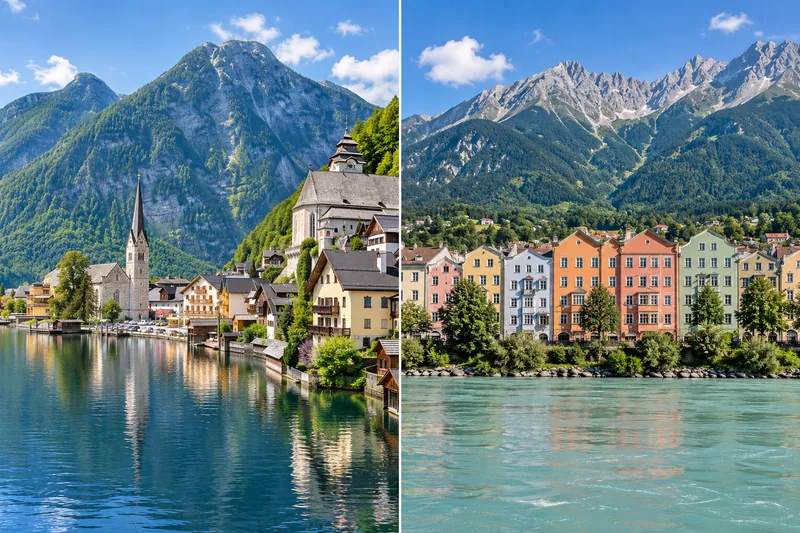
The short answer
Start by protecting Vienna + Salzburg. Then decide what your extra time should buy.
Hallstatt usually costs a sightseeing day. Innsbruck usually costs another base. That difference is the centre of the decision.
- 5 usable days: Vienna + Salzburg, two bases.
- 7 usable days: keep two bases and use one flexible Salzburg-based day for Hallstatt or a focused lakes experience.
- 9 usable days: Innsbruck starts to earn a third base.
- 10+ usable days: Hallstatt and Innsbruck can both work without automatically adding a fourth hotel.
- 11–12 usable days: the same broad structure becomes more forgiving for families, older travellers, slower mornings and weather buffers.
A 6-day Hallstatt version can work, but it is more compressed. An 8-day Innsbruck version can also work, but it gives the Alpine part less breathing room.
In this guide
Hallstatt or Innsbruck: what are you really adding?
| Choice | What it adds | What it costs | Usual base effect |
|---|---|---|---|
| Hallstatt / focused Salzkammergut day | Lake-and-mountain scenery and a strong contrast with the two cities | A full excursion day, several movement stages and less flexibility if the day runs long | Usually no new hotel; keep Salzburg as the base |
| Innsbruck | An Alpine city, mountain context and a westward continuation of the route | A transfer, another check-in and enough time to justify the move | Usually a third base |
| Neither | More Vienna or Salzburg depth, recovery time and simpler logistics | You leave some scenery for another trip | Keeps the core strongest when time is tight |
Hallstatt should not be treated as a tiny stop simply because it can appear close on a route map. Innsbruck should not be added merely because another famous city fits geographically.
The question is whether the experience earns the day or the hotel change.
Match the route to your usable days
In this guide, a usable day is a real sightseeing day. A late arrival or early departure does not automatically count as one.
| Usable days | JnA starting point | Bases | Why |
|---|---|---|---|
| 5 | Vienna + Salzburg | 2 | Protect the core rather than fragmenting the trip |
| 6 | Core + Hallstatt only if the lakes are a strong priority | 2 | Possible, but more compressed and with less buffer |
| 7 | Vienna + Salzburg + Hallstatt / focused lakes day | 2 | The excursion can sit inside a more flexible Salzburg stay |
| 8 | Innsbruck can fit if the Alps are a major priority | 3 | A compressed third-base version with less weather flexibility |
| 9 | Vienna + Salzburg + Innsbruck | 3 | The Alpine base has enough room to feel like more than a transfer |
| 10+ | Hallstatt excursion + Innsbruck | Normally 3 | Both layers can fit without automatically creating a fourth hotel |
| 11–12 | Same broad route, slower | Normally 3 | More forgiving for mixed stamina, slower mornings and weather buffers |
These are planning bands, not official minimum stays. The value comes from protecting the experience each stop is meant to deliver.
Protect the core before adding geography
Vienna: about 3 usable days as a starting point
For a first trip, JnA protects about three usable Vienna days before adding more geography. That gives the city room for culture, architecture, museums or palaces, food and café time, plus some resilience if a sightseeing day changes.
The point is not that every traveller must spend exactly three days. It is that another good Vienna day can be more valuable than another destination pin when the route is already crowded.
Salzburg: roughly 1½–2 usable days
Salzburg is more than a transfer point. Allow roughly 1½–2 usable days for the historic centre, atmosphere, evening walks and a slower contrast with Vienna.
Do not round that into a new two-full-day rule. A transfer/light day can contribute meaningful Salzburg time without becoming a full sightseeing day.
Salzburg also works as the stable base for Hallstatt or a focused Salzkammergut day, which keeps luggage out of the excursion.
What the route can look like
5 usable days: protect depth
One planning example is:
- Days 1–3: Vienna
- Day 4: Vienna → Salzburg, with a lighter Salzburg start
- Day 5: Salzburg local time
That is still a two-base route. The transfer day is not silently converted into a full Salzburg sightseeing day.
7 usable days: add the lakes, not another hotel
Keep the same Vienna core, then use Salzburg as the base for the remaining days. One movable day can become Hallstatt or another focused Salzkammergut experience, with the surrounding time protecting Salzburg and some recovery or weather flexibility.
Six usable days can fit the Hallstatt excursion if it is a strong priority. Seven is the cleaner version because the route depends less on every day going perfectly.
9 usable days: let Innsbruck become a real base
One planning example is:
- Days 1–3: Vienna
- Days 4–5: Salzburg
- Day 6: Salzburg → Innsbruck, with lighter remaining time
- Days 7–9: Innsbruck and a flexible Alpine window
The extra day matters because mountain plans are not strongest when they depend on one single opportunity.
Eight usable days can work when the Alps are a major reason for the trip, but nine gives the third base more breathing room.
10+ usable days: both can work
The clean structure remains:
Vienna → Salzburg → Innsbruck
Hallstatt stays a Salzburg-based excursion rather than becoming an automatic fourth base.
At 10 usable days, this can still be an active route. At 11–12 usable days, it becomes more forgiving for slower travel and weather-dependent Alpine time.
When another hotel earns its place
Use a hotel change only when it creates meaningful value.
Innsbruck earns the move when:
- the Alps are one of the main reasons for the trip;
- you want an Alpine city as well as mountain time;
- you can give the base more than a token arrival-and-departure rhythm;
- a westward route fits the rest of your journey.
A lakes overnight can earn the move when:
- the Salzkammergut itself is the priority rather than a single Hallstatt visit;
- quiet early or late time matters to you;
- you are choosing the lakes instead of Innsbruck, or have enough time to absorb another base.
A lakes overnight is not an automatic upgrade simply because the trip is longer. If you want both Innsbruck and another lakes hotel, test the fourth base more conservatively.
Hallstatt: treat the excursion as a full operating day
Hallstatt is the lower-hotel-friction scenic choice, but not necessarily the lower-energy choice.
Build the day around the full door-to-door excursion: getting from the hotel to the departure point, connections, local movement, sightseeing, waiting and the return to Salzburg. Do not stack several lake towns into the same day merely because they look close on a map.
If poor weather or group energy weakens the excursion, an extra Salzburg day can be the better use of the time.
Innsbruck: buy more than one Alpine opportunity
Innsbruck earns the third base when you are buying Alpine depth, not just another old town.
The stay works best when it can absorb a city day, at least one mountain-oriented day and another opportunity or buffer. That makes the route less dependent on a single perfect-weather window.
Keep mountain planning flexible and check current conditions for the dates you actually travel.
Do you need to add a car?
Treat Vienna → Salzburg → Innsbruck as a public-transport-first route. A car becomes more relevant when you deliberately want dispersed lake villages, rural accommodation or a deeper Salzkammergut route.
That is a separate planning choice from the core Hallstatt-versus-Innsbruck decision. Do not add a car only because the itinerary has several cities.
If finishing in western Austria, compare the departure options available for your dates before automatically returning to Vienna.
Your final decision
Choose Hallstatt when lake-and-mountain scenery deserves a full day but you do not want another hotel. Choose Innsbruck when the Alps deserve their own base and enough time to survive an imperfect-weather day.
Protect Vienna + Salzburg first. Add Hallstatt when a day earns its place. Add Innsbruck when a base earns its place.