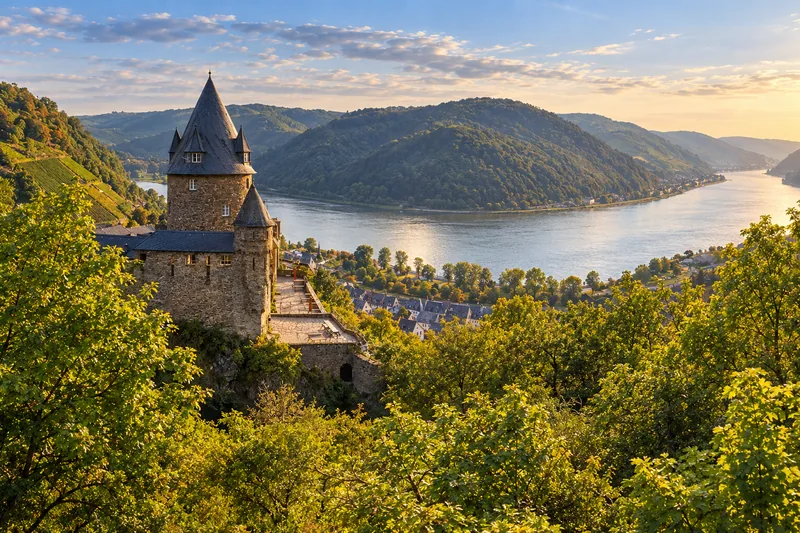
Protect meaningful time in Berlin and Munich first. Then choose the Upper Middle Rhine for river scenery, castles and villages, or the Black Forest for woodland, lakes and a nature-led stay. Add both only when the route can absorb four bases and substantial travel days.
These are JnA planning models in usable route days. They include domestic transfers; international arrival and departure normally sit outside the count. Count the whole hotel-to-hotel move, including station access, connections, luggage and check-in. An arrival evening does not become a full local day.
In this guide
Choose the route by the time you can protect
| Usable route days | Starting point | Protected time and movement |
|---|---|---|
| 7 | Berlin + Munich | 3 full Berlin days, 1 substantial transfer day, 3 full Munich days. Two core bases. |
| 10 | Berlin → Upper Middle Rhine → Munich | 3 full Berlin days, a Rhine transfer day, 2 full Rhine days, a Munich transfer day and 3 full Munich days. The principal Rhine stay is 3 nights. |
| 11 | Berlin → Munich → Black Forest → departure gateway | 3 full Berlin days, a Munich transfer day, 3 full Munich days, a Black Forest transfer day, 2 full regional days and a gateway-positioning day. |
| 14 | Berlin → Rhine → Black Forest → Munich | 3 full Berlin days, 2 full Rhine days, 2 full Black Forest days, 3 full Munich days, 3 substantial transfer days and 1 buffer, gateway or extra local day. Four core bases. |
With fewer than seven usable days, consider one city plus one scenic region. Six days can connect Berlin and Munich, but usually reduces city depth. With eight or nine days, strengthen the city pair, add a gateway buffer or choose one regional excursion before adding another overnight branch.
Choose the Rhine for a focused scenic branch
The scenic branch is the Upper Middle Rhine Valley around Bingen/Rüdesheim–Koblenz. Cologne is a separate city addition.
Choose one base. Start with Mainz or Koblenz when transport practicality matters most; consider Bacharach or St Goar when village atmosphere and valley evenings are the priority. Compare the actual station-to-stay route before deciding, especially with large bags or limited mobility.
Keep the two overnight cases separate:
- Principal 10-day model: 3 Rhine nights and 2 full local days. This is the stronger choice when the Rhine is a main reason for the trip.
- Compressed secondary case: 2 Rhine nights and 1 full local day. Use it only when the Rhine is a secondary branch and the complete transfers leave that local day intact. It does not shorten or replace the principal 10-day model.
One night is too compressed as the default. A day trip can suit travellers who strongly prefer avoiding a hotel change, but it needs a full excursion day and adds out-and-back travel. Keep a rail-based plan; an optional boat trip should depend on what operates for the actual dates.
Choose the Black Forest for two coherent regional days
The Black Forest is a region. Pick a base that serves the part you want to explore.
Freiburg is the rail-first starting point when city evenings and onward connections matter. Titisee is the lake-focused alternative for a stay closer to the landscape. Rail links support a Freiburg–Titisee plan; they do not make every village or trailhead equally convenient.
Begin with the places you can sensibly connect by rail and bus. Consider a short car rental only if your chosen rural stops are genuinely dispersed. The whole trip does not need to become a driving holiday.
The 11-day model protects two full Black Forest days plus a final gateway movement. Do not spend those regional days repeatedly crossing the region or assume the departure transfer is free time.
Add both only when movement works
Fourteen usable days makes both scenic regions defensible, with three substantial transfer days and no extra major branch. It remains an active route.
Thirteen days is a compressed, connection-dependent exception. Without an efficient direction or useful arrival/departure pairing, allow at least 15 days or choose one scenic region. Reverse the route if the actual flights and rail connections work better.
Berlin and Munich are natural city endpoints. Consider Frankfurt as a western rail-and-flight gateway for the Rhine or a Black Forest exit; it need not become another sightseeing base. Stuttgart is conditional on better routing. Basel or Zurich are cross-border alternatives outside Germany, also conditional on the complete journey working better.
Compare arrival and departure hours, positioning travel and any necessary gateway night before committing to the route. Extra famous stops must add time or replace something already planned.
Keep the final choice practical
Choose the city pair if fewer hotel changes or city depth matters most. Choose one scenic branch if it contributes a distinct experience you want. Families, mixed-age groups and travellers with large bags should give extra weight to transfer effort, station access and recovery time.
For the principal scenic-route models, protect two full local days in each added region. Keep the secondary Rhine exception explicitly separate. If actual connections, chosen activities or gateway timing consume that protected time, add time or simplify the route.
For the wider rail structure, use Europe by Train: Build the Corridor Before the Ticket Plan. For regional season choice, use Europe by Season: Match the Region to the Trip You Want.