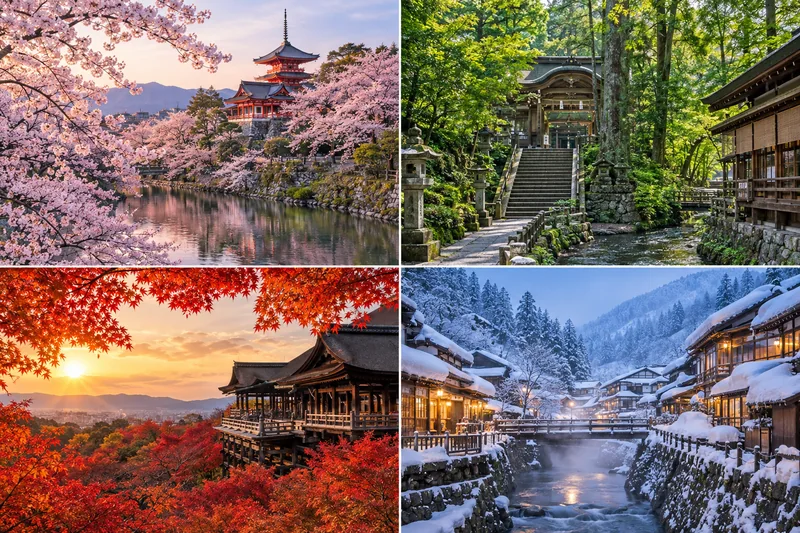
Short answer
Pick Japan by travel goal first, not by a single ‘best month’. Spring and autumn are the easiest broad choices for many first trips, while summer and winter become stronger when festivals, hiking, beaches, snow, skiing or onsen are the actual priority.
In this guide
Choose the season by goal
Japan changes enough by region and season that one national “best time” is too blunt. Use a goal → season → region framework.
| Goal | Broad planning window |
|---|---|
| Cherry blossoms | Late March–early April broadly, later farther north |
| Autumn foliage | October–November |
| Ski / snow | December–February; January–February highlighted for powder |
| Festivals | July–August |
| Hiking / Japanese Alps | July–September |
| Onsen-focused trip | November–March |
| Okinawa beach trip | June–October, with late-summer weather caution |
| Easy city sightseeing | March–May and October–November |
These are broad planning windows, not forecasts. Conditions vary by region and year.
Spring: easiest for classic first-trip scenery
Spring is the strongest fit for blossoms, gardens and city sightseeing, especially for a classic first visit.
The trade-off is demand: blossom periods and holiday weeks can bring heavier crowds and higher prices.
Summer: choose it for a reason
Summer makes more sense when your trip is built around festivals, Hokkaido, mountains or beaches.
Heat, humidity, rain and late-summer typhoon risk are part of the trade-off. Do not choose summer merely because it is school-holiday timing without matching it to the experience you want.
Autumn: broad comfort plus scenery
Autumn is another strong all-round choice. It combines cooler weather with foliage, temples, photography and scenic rail travel.
September still carries weather risk; October and November are the more straightforward city-and-scenery window.
Winter: strongest when snow or onsen matters
Winter is not simply the “cheap season.” It is strongest when snow scenery, skiing, hot springs or winter atmosphere are the reason for the trip.
Tokyo and Osaka can still work as city trips, while Hokkaido, Nagano and Tohoku become more important for snow-focused travel.
First trip versus repeat trip
For a first trip, spring or autumn can support a realistic classic route.
For a repeat trip, shift the decision from “which famous cities?” to “which region or niche experience?” Consider slowing down and spending 2–4 nights in one base rather than changing hotels daily.
Final decision
Start with your goal. Then choose the season and region that serve it.
Keep transport planning separate: this page does not decide whether a JR Pass, regional pass or individual tickets are right for your route.