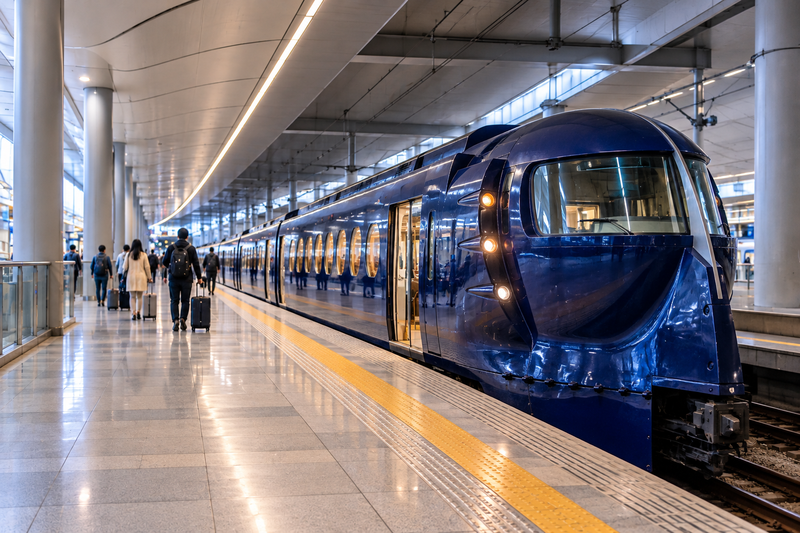
Choose by the exact hotel entrance. For Namba, compare Nankai first. For Tennoji or Osaka Station/Umeda, start with JR. For Kyoto, compare HARUKA first. An airport bus can win when its actual stop removes a difficult transfer or hotel approach.
In this guide
Namba: distinguish the services and arrival points
Nankai runs directly to Nankai Namba. Airport Express uses an ordinary fare and does not provide a reserved seat. Rapi:t provides reserved seating with a limited-express charge. Decide whether that comfort is useful after checking the station-to-hotel walk.
Nankai Namba is not OCAT/JR Namba. A booking labelled “Namba” is not enough to establish which arrival point is easiest. Check the exact station or bus stop, exit, lifts and route to the hotel door.
Tennoji and Osaka Station: compare both JR options
HARUKA and Kansai-Airport Rapid both serve Tennoji and Osaka Station directly. At Osaka Station, HARUKA uses underground platforms and requires a limited-express ticket. Kansai-Airport Rapid uses Loop Line platforms, with ordinary-fare, unreserved seating.
The platform-to-hotel walk can change the practical ranking. For an address around Shin-Osaka or elsewhere beyond these examples, check the exact service and station rather than treating “Osaka” as one interchangeable endpoint.
Kyoto: station first, hotel next
HARUKA runs directly to Kyoto Station. The airport bus serves the Hachijo side. Neither means you have arrived at every Kyoto hotel's doorstep. Include the station side, onward transport, luggage and final walk when comparing the complete trip.
Choosing Kyoto versus Osaka as an overnight base is a separate decision. This guide starts with a hotel already selected.
When the airport bus makes sense
Compare the current exact stop, departure and luggage rules. A useful hotel-area stop may remove a rail transfer. Traffic, a full bus or the wait for the next service can change the journey.
Use the current route timetable rather than an old stop map. Check boarding requirements and the remaining hotel walk; “airport bus” does not mean door-to-door service.
Terminal 2 adds a rail-access step
Kansai-airport Station is beside Terminal 1/Aeroplaza. From Terminal 2, take the free shuttle to Aeroplaza, then walk to the railway station. Allow for the shuttle wait, ride and station access. There is no railway platform at Terminal 2.
This is the process for taking a train; check the actual boarding arrangements separately if you choose an airport bus.
Tickets, luggage and access
Rapi:t and HARUKA are limited-express services. An ordinary IC-card or base-fare payment alone does not cover the limited-express ticket. Check the exact product's eligibility, collection, activation and train or seat-reservation rules.
A reserved seat does not prove a step-free journey. Check lifts, platform changes, walking distance and any assistance arrangements. For buses, verify baggage limits and boarding requirements. Compare the complete route for the person with the greatest access or luggage burden.
Late arrivals need a workable fallback
Immigration, bags and terminal travel come before boarding. Check the last service you can realistically use and its onward connection, rather than comparing departure time with scheduled landing time.
If no public-transport route works, price a taxi or transfer, or check an airport-area overnight stay before travel. Confirm the hotel's late check-in arrangements. Do not assume a train, bus seat or onward connection will be available.
Before buying, confirm the terminal, pin the hotel entrance, compare the whole trip and check current operator timetables, ticket rules and service notices.