Short answer
Use Kashgar as the starting base, treat the Pamir road as the main experience and make Tashkurgan the destination rather than a rushed turnaround point.
An overnight can improve pacing when the wider route allows, but there is no universal night count, two-day minimum or exact drive-time rule.
In this guide
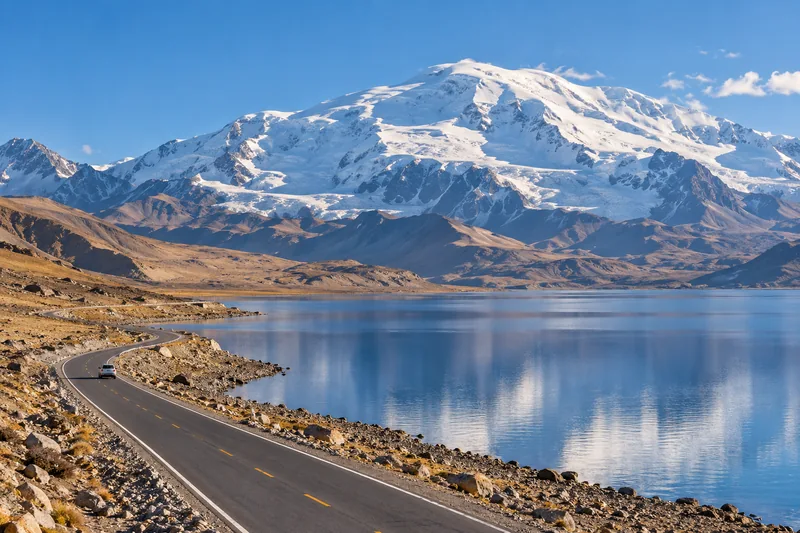
The road is the experience
Use this broad sequence:
Kashgar → Pamir landscape → selective lake/valley stops → Tashkurgan
This is not a route where the transfer is simply dead time. The journey itself is the reason to go.
Kashgar functions as the starting base. The Pamir Plateau is the scenic corridor. Tashkurgan gives the road a clear destination.
Keep scenic stops selective
Choose fewer, better stops rather than trying to stop at every viewpoint.
Karakul Lake and Baisha Lake are scenic-stop options, not a fixed stop sequence or navigation instructions.
Leave enough margin that a slower road day does not force every later stop into a rushed checklist.
Use Tashkurgan as an anchor
Give Tashkurgan more space than a turnaround stop.
Stay overnight if the wider schedule makes sense and you want the route to breathe. Keep the first highland day lighter in sightseeing terms rather than stacking another dense programme on top of the road journey.
That is a pacing choice, not a numeric duration rule.
Return or continue
After Tashkurgan, make a separate route decision:
- return to Kashgar if the wider itinerary loops back to the city
- continue onward only when the broader Southern Xinjiang route genuinely supports it
Exact road times and the onward route need trip-specific planning; neither is fixed here.
Final decision
Use this guide when the Pamir road itself is one of the trip highlights.
Start from Kashgar, keep the scenic stops selective, let Tashkurgan function as a real destination and avoid treating the whole extension as a rushed same-day add-on.