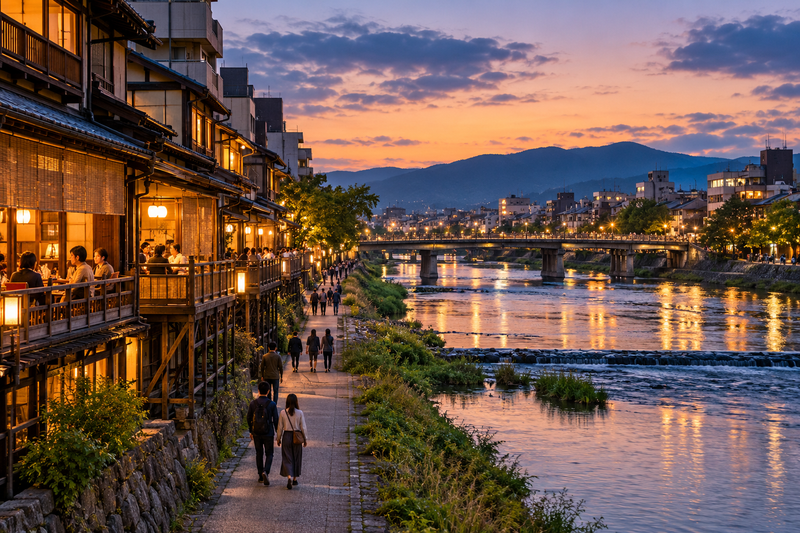
For a typical first visit of about 3–4 nights, with most days inside Kyoto and no unusually late arrival, early departure or strongly JR-based excursion pattern, start with the central Shijo corridor. Then distinguish Shijo-Karasuma from Shijo-Kawaramachi: they are meaningful alternatives, not interchangeable names.
Choose Kyoto Station when arrival, departure and JR use dominate. Choose Gion/Higashiyama when early or late eastern-Kyoto walks are themselves a reason for the stay and you accept the extra access constraints.
In this guide
Four bases, four different strengths
- Shijo-Karasuma: a central balance of the Karasuma subway and Hankyu, useful when reducing bus dependence matters.
- Shijo-Kawaramachi: central dining, shopping, evening returns and walking toward Gion.
- Kyoto Station: major arrival and departure, JR/Shinkansen use, airport rail and luggage handling.
- Gion/Higashiyama: early-morning and evening eastern-Kyoto atmosphere, with more exact-property and walking checks.
A hotel should solve the movement you repeat most. No area wins all four kinds of convenience.
Karasuma and Kawaramachi are different micro-locations
Shijo-Karasuma lies west of Shijo-Kawaramachi. Subway Shijo and Hankyu Karasuma connect through an underground passage; Kyoto-Kawaramachi is a separate Hankyu station farther east.
Near the Kawaramachi intersection, Hankyu and central shops matter. Closer to the river and Gion-Shijo, Keihan and eastern walks may become more useful. Moving west toward Karasuma changes the balance toward the subway. Do not book from a broad “Kawaramachi” label without checking the pin.
Kyoto-Kawaramachi is west of the Kamo River; Gion-Shijo is on the east side. They are distinct stations, although the areas are close enough that a river crossing may be practical. Kyoto Station lies south of the central Shijo corridor; it is not the same stop as any of these.
When Kyoto Station wins
Compare it first when a late arrival, early departure, heavy bags, repeated Shinkansen/JR use or the HARUKA airport connection materially shapes the stay. Storage or luggage delivery may help make the transfer easier.
Its strength is reducing arrival and departure effort, not making every Kyoto attraction closest. Check the station side, useful exit and actual route to the hotel; large-station walking still counts.
Do not assume every day trip favours Kyoto Station. Match the railway to the excursion: JR-oriented journeys differ from Hankyu via Katsura for Arashiyama or Keihan for the eastern/southern corridor.
When Gion or Higashiyama wins
Choose it when early or evening walks in eastern Kyoto are part of the experience you intend to use, rather than a single sightseeing visit. Gion-Shijo's Keihan access can be useful, but deeper Higashiyama means more attention to slopes, steps, luggage and taxi approach.
A beautiful street is not proof of an easy hotel entrance. Check whether a vehicle can reach the property, the final walk, crowded streets, lifts and room suitability. Accept those trade-offs deliberately.
Nights change the weighting, not the answer
Around two nights, the one-time arrival and departure can carry more weight. With three nights, repeated daily travel becomes more important. With four or five, evening use, rest breaks and excursion pattern may matter more than one easy arrival.
These are not automatic area rules. Even a short stay with full Kyoto sightseeing days can favour central or eastern Kyoto. A longer stay dominated by JR trips can still favour Kyoto Station.
Test the actual hotel entrance
Compare the walking route to the station and exit you will use, not the closest station symbol. Include road crossings, the river, stairs, underground passages and station interiors. Check evening meals, tired returns, lifts, luggage storage/delivery and taxi drop-off where needed.
For children, older companions or anyone who tires with repeated changes, reduce the actual burden instead of assuming one district is universally best for families. Room size, beds and occupancy are property-level checks.
Consider rail, subway and walking combinations before assuming a direct bus is easiest. Crowding and road congestion can change the value of a bus route, particularly in busy sightseeing periods.
This guide decides where to stay inside Kyoto. Keep the broader Osaka-versus-Kyoto base decision and the number of Kyoto sightseeing days separate.