Short answer
If your South Island route already passes through Lake Tekapo and the night sky matters to you, an overnight can add a completely different experience from a daytime stop. Clear sky and moon conditions matter more than forcing a particular month.
In this guide
The decision is daytime stop versus after-dark experience
Keep the decision focused on whether the after-dark experience matters to your trip.
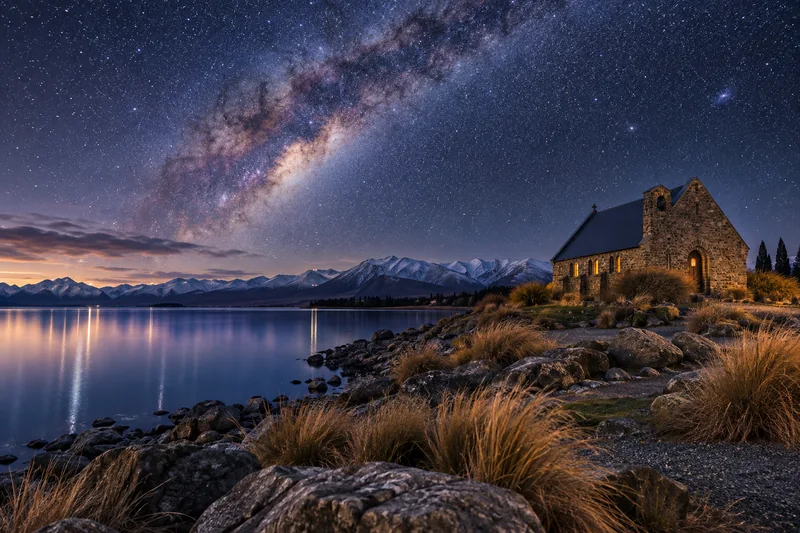
By day, Tekapo gives you the lake, mountain scenery and the Church of the Good Shepherd context. After sunset, the focus shifts to stars, darkness and night photography.
If that contrast matters, do not treat Tekapo only as a daylight photo stop.
When staying overnight is worth it
Stay overnight if you can and if the night-sky experience is one of your priorities.
There is no fixed number of nights or hours, or required arrival time. Treat “overnight” as a stay choice rather than a duration band.
Conditions matter more than the calendar
The strongest practical condition is: clear skies matter more than the month.
Consider checking moon phase, bringing warm layers, keeping lights low and using a tripod for sharper night photographs.
These are experience conditions, not viewing guarantees. An “aurora-like glow” is not confirmation of an aurora sighting.
Keep this separate from the wider New Zealand route
The national New Zealand guide mentions Tekapo as one possible overnight experience. This page answers a different question: why staying after dark can be worth it once Tekapo is already on your route.
Final decision
If Tekapo is already on the route and night-sky viewing matters, stay after dark rather than treating it as a pass-through daylight stop. If the weather does not cooperate or stargazing is not a priority, an overnight is not automatically necessary.