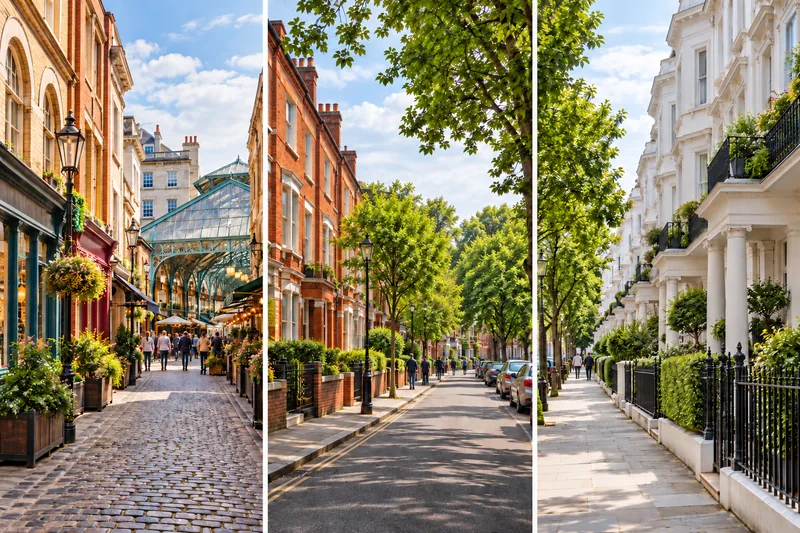
Short answer
There is no universal winner. For a short first trip focused on central walking, theatre and dining, Covent Garden/Strand is the strongest starting point. Choose Waterloo/central South Bank for river and Westminster geography, family landmarks and useful rail connections. Choose South Kensington/Gloucester Road for museums, families, a calmer base, western airport logic and longer-stay room needs.
For most short and four-night first trips, keep one hotel. As the stay gets longer, room comfort matters more—but a longer stay does not automatically mean moving farther out or splitting hotels.
In this guide
Quick comparison
| Base | Best fit | Main advantage | Main trade-off |
|---|---|---|---|
| Covent Garden / Strand | Theatre, dining, central walking, short first trip | Repeated central journeys can disappear | Premium prices, compact rooms, crowds and noise |
| Waterloo / central South Bank | River, Westminster, family landmarks, rail | Strong mixed sightseeing/transport base | Large-station and bridge walking; exact pin varies greatly |
| South Kensington / Gloucester Road | Museums, family, calmer evenings, longer stays | Museum/park access, room/apartment options and western gateway logic | More public transport to West End, South Bank and eastern sights |
| Bloomsbury / Holborn | Central-but-quieter/value alternative | Central position without needing the busiest core | Less “doorstep theatre” than Covent Garden |
Covent Garden / Strand
This is the strongest fit when the trip repeatedly uses the West End: theatre nights, dining, Soho/Chinatown, Trafalgar Square and central walking.
It is especially strong for 2–4 NIGHTS, provided the room itself works. The trade-offs are real: premium pricing, compact rooms, crowds, nightlife noise and sometimes awkward vehicle access.
Do not book the district name alone. A quieter Strand/Aldwych edge or side street may work better than a famous but noisy pin.
Waterloo / central South Bank
Waterloo and the central South Bank fit trips built around the river, Westminster, family landmarks and practical transport.
A riverside hotel and a hotel on the Waterloo/Lower Marsh side do not create the same daily routine. Large stations, bridges and internal walking can add friction, so the exact entrance and hotel pin matter.
A river view is not proof of an easy transport chain.
South Kensington / Gloucester Road
This is the strongest of the three for museum-focused families, travellers who want a calmer base, apartment-style stays and some western-airport convenience.
South Kensington and Gloucester Road are related but not identical microbases. Check the actual station, room, entrance and evening dining around the property.
The trade-off is simple: more journeys to West End, South Bank and eastern London.
How the answer changes at 2, 4 and 7 nights
2 NIGHTS
Two hotel nights do not automatically mean two full sightseeing days. A late arrival plus early departure can leave only one complete day.
With so little time, keep one hotel and prioritise repeated convenience. Covent Garden/Strand is strong for central walking and theatre; Waterloo can win for river/family/rail priorities; South Kensington can win for museums, Heathrow-side logic or room comfort.
4 NIGHTS
Four nights are the balanced first-trip case, and one hotel remains the default.
Pay a central premium only if it removes real daily friction. A well-positioned Waterloo, South Kensington or Bloomsbury/Holborn room can outperform a more famous address that does not match your itinerary.
7 NIGHTS
At seven nights, the room matters more: size, beds, lift, storage, laundry/kitchenette potential, quiet and nearby everyday services.
That can increase the value of South Kensington/Gloucester Road, Waterloo or Bloomsbury/Holborn. It does not mean you must move farther out, and it does not create a split-stay requirement.
Useful alternatives and gateway exceptions
Bloomsbury/Holborn is the main central-quieter/value alternative. Earl's Court can work when room/apartment space and western geography matter more.
A gateway area—such as one aligned with a high-stakes airport or rail departure—should override the normal sightseeing base only when that journey genuinely controls the stay. A final-night move is a specialist solution for a real departure, luggage, mobility or disruption problem, not a routine London strategy.
Accessibility and luggage
Judge the whole route: hotel entrance, pavement/crossings, exact station entrance, lifts, interchange and final exit.
A neighbourhood cannot be declared “accessible” in the abstract. For large bags or mobility constraints, the simplest real route can be more valuable than the shortest map distance.
Final decision
Choose the base whose advantage repeats every day. Start with Covent Garden/Strand for central walking and theatre, Waterloo for river/family/rail priorities, and South Kensington/Gloucester Road for museums, calmer stays and longer-stay room needs.
Then let the exact hotel pin, room and station route make the final call.