Short answer
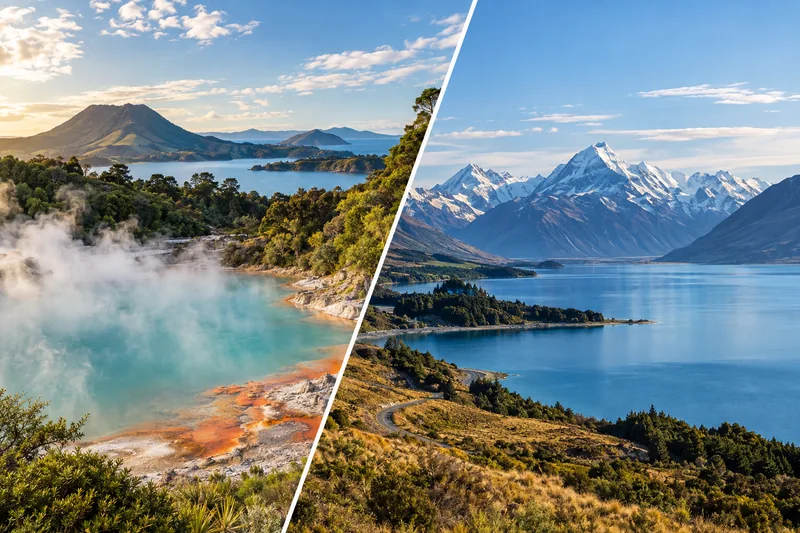
For a short trip, choose one island. North Island is the stronger fit for cities, geothermal areas, Māori culture and beaches; South Island for mountains, lakes, fjords, road trips and alpine scenery. Allowing 2–3 weeks works better if you genuinely want both.
In this guide
Choose the island before the itinerary
The most useful national decision is simple: do not assume a short New Zealand trip should cover both islands.
| Choice | Stronger trip fit |
|---|---|
| North Island | Auckland, Rotorua, geothermal areas, Māori culture, Hobbiton, beaches, city-to-nature routes |
| South Island | Mountains, lakes, fjords, road trips, dark skies, dramatic scenery |
| Both islands | More realistic when the trip reaches 2–3 weeks |
North Island: city, culture and geothermal variety
One first-route example is Auckland → Rotorua → Taupō → Wellington, with Hobbiton or Waitomo added by interest.
The route is illustrative, not a fixed timetable. Use it when your priorities lean towards culture, geothermal landscapes and a city-to-nature trip.
South Island: scenery and road-trip depth
A simple South Island route is Christchurch → Lake Tekapo → Aoraki / Mount Cook → Queenstown, with Wānaka or Milford Sound added if time allows.
This side of the country is the stronger fit when mountains, lakes, fjords and scenic driving are the main reason for going.
When both islands make sense
The clearest guideline is 2–3 weeks works better for both islands.
A shorter “7–12 days” range is not the guideline for combining both islands.
Weather and transport change the route
New Zealand needs more buffer than the map suggests. Plan more slowly and allow buffer days for weather-sensitive places such as Milford Sound or Aoraki / Mount Cook.
It also recognises non-driving options. Self-drive is not the only supported way to travel.
Final decision
Short trip: choose one island. Pick North for culture/geothermal/city-to-nature travel; South for mountains/lakes/fjords/road trips. Combine both when you have enough time to absorb the transfer and weather uncertainty—2–3 weeks is the stronger both-islands guideline.