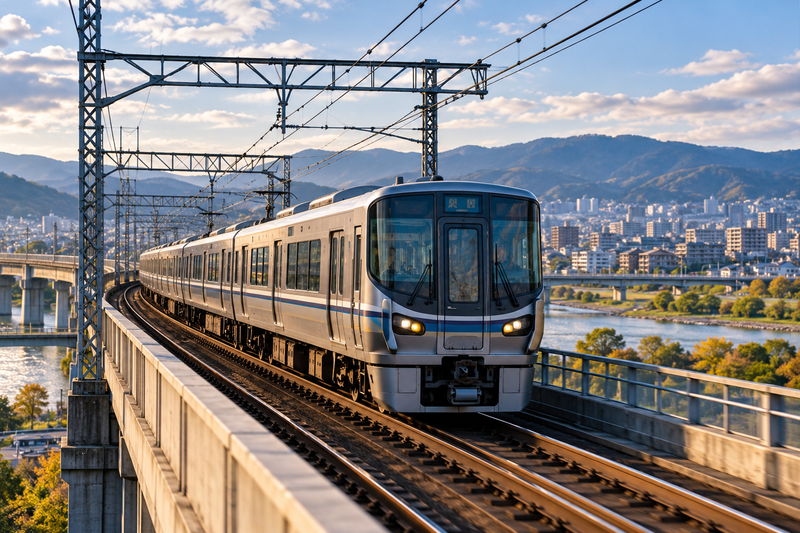
Match your actual Osaka starting point with the first place you will visit in Kyoto. JR, Hankyu and Keihan arrive at different parts of the city. Count station access, finding the correct railway, transfers and the final walk—not only the intercity ride.
Start by comparing JR for Kyoto Station, Hankyu for the Shijo/Kawaramachi corridor and Keihan for Gion-Shijo or Sanjo. Then test that choice against the Osaka hotel. The return railway can be different.
In this guide
JR: useful when Kyoto Station is the right arrival
JR Special Rapid ordinary carriages connect Osaka Station with Kyoto Station. This is a strong starting comparison when you want the station area or an onward connection there.
Kyoto Station is not Shijo-Kawaramachi, and eastern Kyoto still has a final leg. Arriving in Kyoto does not mean arriving at the attraction.
Osaka Station and Shin-Osaka are distinct. If starting at Shin-Osaka, compare the complete journey from that actual station; do not silently substitute Osaka Station in the route search.
Hankyu: arrive in the Shijo corridor
Hankyu connects Osaka-Umeda with Karasuma and Kyoto-Kawaramachi. It deserves an early comparison for a first stop around Shijo or Kawaramachi, especially when you begin near Umeda.
From Namba, include the connection to Umeda and the time to find the correct boarding location. Hankyu Osaka-Umeda is not the same boarding point as JR Osaka. Choose Karasuma or Kyoto-Kawaramachi according to the actual first stop.
Keihan: compare both the Osaka origin and Kyoto's east side
Yodoyabashi, Kitahama and Kyobashi are useful Osaka-side starting points for comparison with Gion-Shijo or Sanjo. If your starting point is near one of them, first travelling to Umeda may be unnecessary.
Gion-Shijo is still not the entrance to Kiyomizu-dera. Check the service's actual stopping pattern and final walk. Kyoto-Kawaramachi is west of the Kamo River; Gion-Shijo is east. They are separate stations, even where walking across the river is useful.
Worked examples: the origin changes the answer
- Umeda to Shijo-Kawaramachi: start with Hankyu to Kyoto-Kawaramachi.
- Kyobashi to Shijo-Kawaramachi: compare Keihan to Gion-Shijo followed by the river crossing; do not automatically detour via Umeda.
- JR Osaka Station to Kyoto Station: start with JR Special Rapid.
These examples use those exact starting points. Add the hotel's access leg and final destination walk before deciding.
First stop Fushimi Inari?
Compare JR via Kyoto Station and the Nara Line to Inari with Keihan to Fushimi-Inari using a stopping service or appropriate transfer. Keihan Limited Express does not stop at Fushimi-Inari.
The two stations are different, and both still require walking to the shrine entrance. Compare the full route from your actual Osaka origin; do not reuse a city-centre recommendation without checking it.
First stop Arashiyama?
For JR, compare Kyoto Station then the Sagano Line to Saga-Arashiyama. For Hankyu, compare the route via Katsura and the Arashiyama Line.
The JR and Hankyu stations are not in the same place. Decide where your Arashiyama visit begins and compare the walk from each station. A route that works for central Kyoto is not automatically best for western Kyoto.
Ordinary seats and paid seats are different
JR Special Rapid, Hankyu Limited Express and Keihan Limited Express have ordinary seating available at ordinary fares. Extra-cost reserved products such as A-seat, うれしート, PRiVACE and Premium Car require separate checks of seat charges and purchasing rules.
An IC card helps with entry and exit; it does not include paid-seat reservations. Check the carriage designation before boarding if unsure.
Return from where the evening actually ends
You might arrive at Kyoto Station in the morning and finish dinner in Gion. Compare Keihan from Gion-Shijo back to Osaka, followed by the hotel connection, instead of assuming the return must retrace the morning route.
Check the last usable service, the final hotel leg and any pass coverage you already hold. Use exact station and destination names in route searches, and check departure-day service notices. This is a railway-selection guide, not a complete Kyoto itinerary or a recommendation to buy a rail pass.