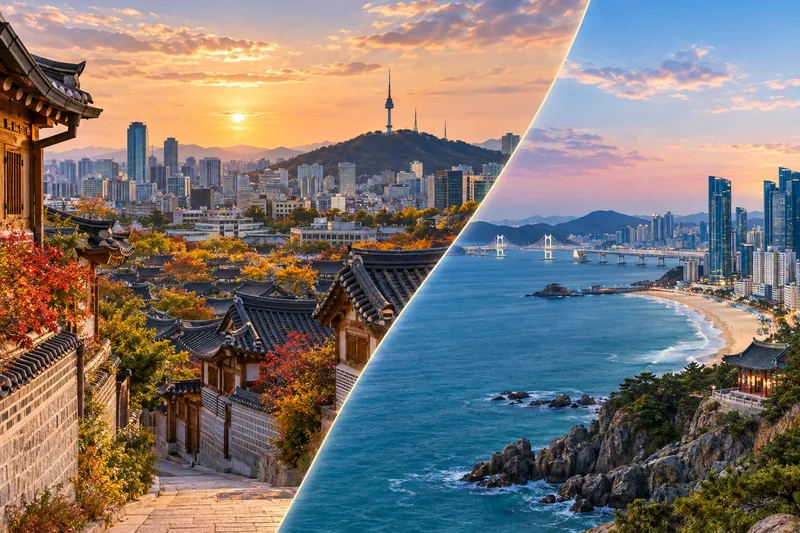
Short answer
At 4–5 days, keep the trip mainly in Seoul unless you are comfortable moving very fast. At 6–7 days, about 4 days in Seoul plus 2–3 days in Busan can work. At 8–10 days, slow down or add cultural depth such as Gyeongju rather than automatically adding another base.
In this guide
The key question is whether Busan earns the transfer
| Trip length | Better route shape |
|---|---|
| 3–4 days | Do not force both cities |
| 4–5 days | Mainly Seoul; Busan only as a fast-travel exception |
| 6–7 days | Seoul 4 days + Busan 2–3 days |
| 8–10 days | Slower Seoul/Busan depth or consider Gyeongju |
Avoid treating Busan as only a day trip.
Seoul: protect the first-city depth
Seoul is the main first-arrival, culture, food and shopping base.
Neighbourhoods such as Jongno/Insadong, Myeongdong, Hongdae, Seongsu and Gangnam are different day-zone choices, not a reason to change hotel repeatedly.
Busan: give the coast real time
Busan adds beaches, markets and coastal scenery, but those experiences are geographically spread out.
Haeundae/Gwangalli and the Nampo/Jagalchi side are not one compact walk. Allowing 2–3 days makes Busan more than a rushed add-on.
Move-day rule: keep it light
A train day should remain light. For families or slower travellers, a rhythm of one major morning sight, an indoor/café break and a flexible evening can work well.
When Gyeongju enters
At 8–10 days, Gyeongju becomes a culture-focused option. It is not an automatic third base.
Final decision
4–5 days: Seoul first. 6–7 days: Seoul + Busan becomes the stronger two-city shape. 8–10 days: add depth before adding complexity.