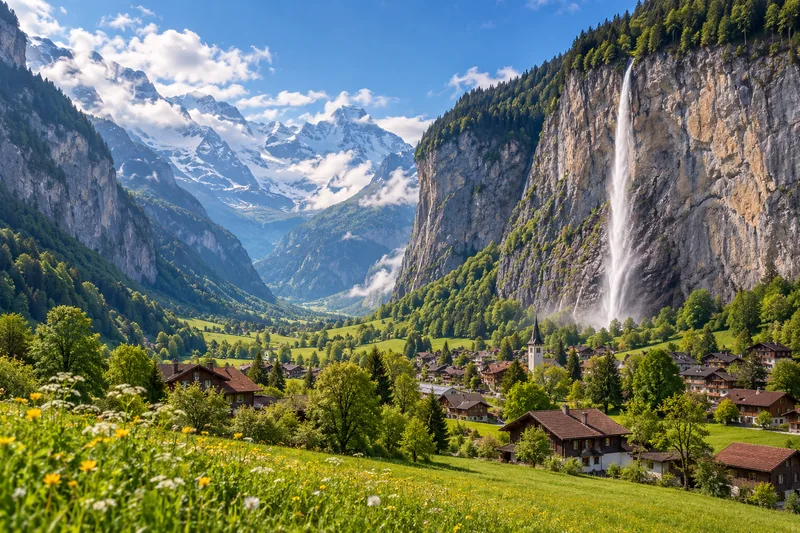
Swiss trains make it tempting to add another mountain town whenever the map looks connected. But every extra base costs a hotel change, luggage movement and—most importantly—one more piece of your mountain-weather flexibility.
The decision is not how many famous places can fit. It is how many bases can still receive enough local time to justify the transfer.
In this guide
Count usable route days
A usable route day is part of the trip you can plan around, including major transfer days. It is not the same as a full local mountain day, a weather opportunity or a hotel night.
| Usable route time | Practical base structure |
|---|---|
| 5–6 usable route days | 2 bases: Lucerne + Jungfrau Region |
| 7–8 usable route days | Still 2 bases: balanced or mountain-first |
| 9+ usable route days | 3 bases: Lucerne + Jungfrau Region + Zermatt |
Do not convert these thresholds into a universal nights formula. The point is to protect real time in each region.
5–6 usable route days: Lucerne + Jungfrau Region
Use two bases.
Lucerne
Lucerne adds a city-and-lake layer, an easier first base and useful lower-level options when mountain conditions are poor.
Jungfrau Region
The Jungfrau Region is the main mountain block. Give it enough local time to move your highest-priority mountain outing to the clearest weather window rather than locking every day in advance.
With this amount of time, do not add Zermatt automatically. A third base usually takes more flexibility than it adds.
7–8 usable route days: still choose 2 bases
This is the key decision point.
Balanced first trip: Lucerne + Jungfrau Region
Choose this when you want:
- city and lake variety;
- a broader first-Switzerland mix;
- fewer luggage transfers;
- more non-mountain or poor-weather alternatives.
Mountain-first trip: Jungfrau Region + Zermatt
Choose this when the Matterhorn, hiking, alpine villages or mountain photography matters more than Lucerne.
At seven or eight usable route days, Zermatt should replace Lucerne rather than join it. The route remains two bases; only the trip style changes.
9+ usable route days: three bases become defensible
Now the complete core route can work:
Lucerne → Jungfrau Region → Zermatt
The extra time matters because Zermatt should have more than a token overnight and the Jungfrau Region still needs a real weather window.
For families, slower travellers, heavy luggage or shoulder-season trips, additional time strengthens this route more than another destination would.
The Jungfrau Region is one region, not five bases
Interlaken, Grindelwald, Lauterbrunnen, Wengen and Mürren are different stay choices within the same mountain region. Do not count them as separate regional stops.
A simple way to frame the decision:
- Interlaken when operations, broader accommodation, late arrivals and easier luggage handling lead;
- Grindelwald when mountain immersion and the Eiger side are the priority;
- Lauterbrunnen, Wengen or Mürren when their specific valley or village experience is important enough to accept the access trade-off.
The exact property location matters because a scenic village label does not tell you how easy the final luggage route will be.
When does Zermatt earn the transfer?
Zermatt is strongest when the Matterhorn and a second high-mountain system are genuine trip priorities.
Keep its nights separate from route-day arithmetic:
- 1 night: mostly arrival, an evening and departure—a token stop;
- 2 nights: one real local day, but limited weather flexibility;
- 3 nights: a stronger stay with more room to reposition mountain plans.
At 7–8 usable route days, use Zermatt as the mountain-first replacement for Lucerne. At 9+ usable route days, it can become the third base.
Montreux and scenic rail are not free additions
Montreux is a substantive route choice, not a stop that can simply be inserted because a scenic line exists.
Use Montreux or a scenic-rail layer when the journey itself, the lake region or western Switzerland is a real priority. Otherwise, protect the time in Lucerne, the Jungfrau Region and Zermatt.
The same applies to Ticino and St. Moritz: they are strong conditional modules for a longer or differently focused trip, not required parts of the classic core.
Route first, rail product second
Build the regional route and mountain priorities before choosing passes or ticket products. Rail-product optimisation is a separate decision and should not determine the trip shape before the bases are settled.
Mountain operations and visibility can change. Check current operating information and weather close to the travel day, especially before committing an expensive mountain outing to one fixed date.
The simplest first-Switzerland rule
- 5–6 usable route days: Lucerne + Jungfrau Region.
- 7–8 usable route days: still two bases—balanced Lucerne + Jungfrau or mountain-first Jungfrau + Zermatt.
- 9+ usable route days: Lucerne + Jungfrau Region + Zermatt.
- Montreux, Ticino, St. Moritz and scenic rail are conditional branches, not automatic additions.
The strongest Switzerland route is the one with enough time and weather flexibility to enjoy the bases you already chose.