Short answer
Choose the destination by trip style first, route second.
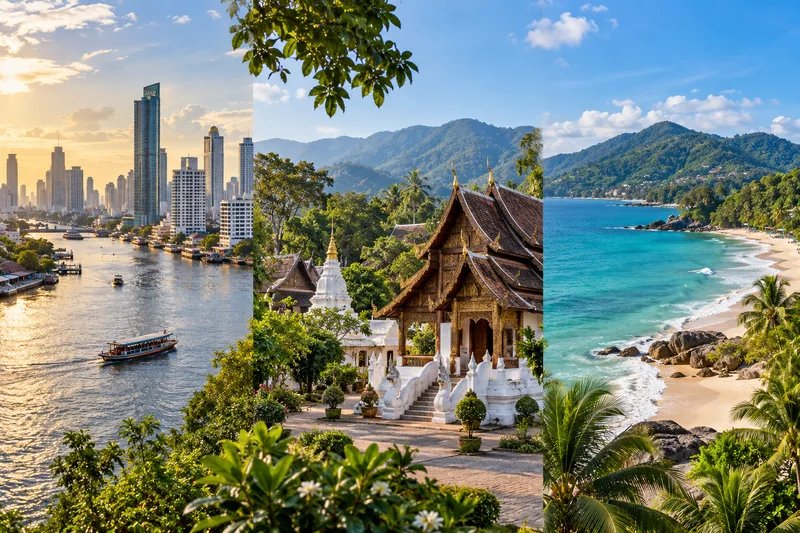
- Bangkok is the broad classic first-timer choice: food, temples, shopping, nightlife and the strongest no-car urban transport.
- Chiang Mai is for northern culture, food, markets, activities and a slower pace—when air quality and season suit the trip.
- Phuket is for beach/resort downtime, family leisure and sea activities—when the hotel area and ground transport are planned together.
With 4–7 TOTAL DAYS, choose one destination. With 9–13 TOTAL DAYS, two destinations are the normal range. 14–15 TOTAL DAYS can support all three. An 8-day two-stop trip is a brisk exception, not the default.
In this guide
Count total days correctly
TOTAL DAYS include arrival, departure, airport transfers and hotel movement.
A domestic flight is not just airborne time. Allow roughly HALF A TRAVEL DAY door-to-door for a flight move when planning.
Protect the DEPARTURE DAY rather than pretending it is a normal sightseeing day.
Which destination fits you
| Destination | Choose it for | Think twice when |
|---|---|---|
| Bangkok | Classic urban Thailand, food, temples, shopping, nightlife, strong transit | Beach is the main priority or you dislike fast urban energy |
| Chiang Mai | Northern culture, markets, temples, food, activities, calmer pace | Air quality is poor, beach/nightlife is the main goal, or you dislike activity planning |
| Phuket | Beach/resort time, island/sea activities, family leisure, slower pace | You expect a compact walkable city or dislike road-based movement |
Bangkok
Bangkok is the broad first-trip default because it covers the widest range of classic Thailand experiences and is the easiest of the three for a non-driver to navigate.
Choose the hotel area for the repeated daily route—not because the city has one universal “centre.”
Chiang Mai
Chiang Mai fits travellers who want northern food, temples, markets, cafés/crafts and activity or nature days at a slower pace.
Its biggest override is air quality. A route that looks ideal on paper can become a poor fit if haze is severe.
Phuket
Phuket is the beach/resort specialist. Choose the beach area before the hotel because ground movement changes significantly by base.
A second hotel is not automatically better; split only when it solves a genuinely different priority.
How many stops fit the trip
| TOTAL trip time | Route default |
|---|---|
| 4–7 DAYS | One destination. About 4–5 is focused; 6–7 gives depth/flexibility. |
| 8 DAYS | Brisk Bangkok + one exception only when arrival, departure and the domestic flight are unusually efficient. |
| 9–13 DAYS | Two destinations at a good pace. |
| 14–15 DAYS | All three can work, accepting three hotels and two domestic-flight operations. |
Use these approximate pair ranges:
- Bangkok + Chiang Mai: about 9–10 TOTAL DAYS
- Bangkok + Phuket: about 9–10 TOTAL DAYS
- Chiang Mai + Phuket: about 10–11 TOTAL DAYS, conditional on a practical nonstop
- all three: around 14–15 TOTAL DAYS
The broad two-stop default is Bangkok + one contrasting destination.
How much time each destination can use
These are FULL DAYS at the destination, not the same unit as TOTAL trip days.
Bangkok
- 3 FULL DAYS: compact city trip
- 4 FULL DAYS: strongest short first-trip balance
- 5 FULL DAYS: one deeper food/market/cultural layer or selected day trip
Chiang Mai
- 3 FULL DAYS: city temples, food/markets, neighbourhoods and flexible culture
- 4–5 FULL DAYS: add one nature/activity/craft layer or slower regional excursion
- 6 FULL DAYS: second activity, slower city time or weather recovery
Phuket
- 4 FULL DAYS: one base, beach/resort time, one condition-dependent activity and flexibility
- 5–6 FULL DAYS: second activity or slower beach time
- 7 FULL DAYS: slower pace, not automatically more hotels
Nights remain a different unit
These route examples use approximate NIGHTS:
- the 8-day brisk exception can look like Bangkok about 3 NIGHTS plus Chiang Mai or Phuket about 4 NIGHTS, only when the flight and arrival/departure pattern are unusually efficient;
- within 9–13 TOTAL DAYS, examples include Bangkok about 4 NIGHTS + Chiang Mai about 4–5 NIGHTS, Bangkok about 4 + Phuket about 5–6 NIGHTS, or Chiang Mai about 4 + Phuket about 5–6 NIGHTS when the flight works;
- around 14–15 TOTAL DAYS, the all-three example is Bangkok about 4 NIGHTS + Chiang Mai about 4 + Phuket about 5–6 NIGHTS.
These are approximate route shapes, not a rule that TOTAL DAYS, FULL DAYS and NIGHTS are interchangeable.
When season and conditions change the answer
Several conditions can override the broad choice:
- Chiang Mai haze risk is commonly February into April, with timing and severity varying annually.
- Phuket is roughly November–April for more settled beach/sea conditions and roughly May–October for wetter, rougher conditions; day-to-day conditions still vary.
- Bangkok's heat can increase the value of shade, indoor resets and a well-positioned hotel.
Check the actual air quality, weather and sea conditions close to the trip rather than treating a seasonal label as a guarantee.
Final decision
Classic first trip? Start with Bangkok. Choose Chiang Mai when northern culture and a slower activity-led trip matter more and the air suits. Choose Phuket when beach/resort time is the priority and the base/transport setup works.
Then apply the time gate: 4–7 total days one destination; 9–13 two; 14–15 all three. Treat eight days as a brisk two-stop exception, not the new default.