The short answer
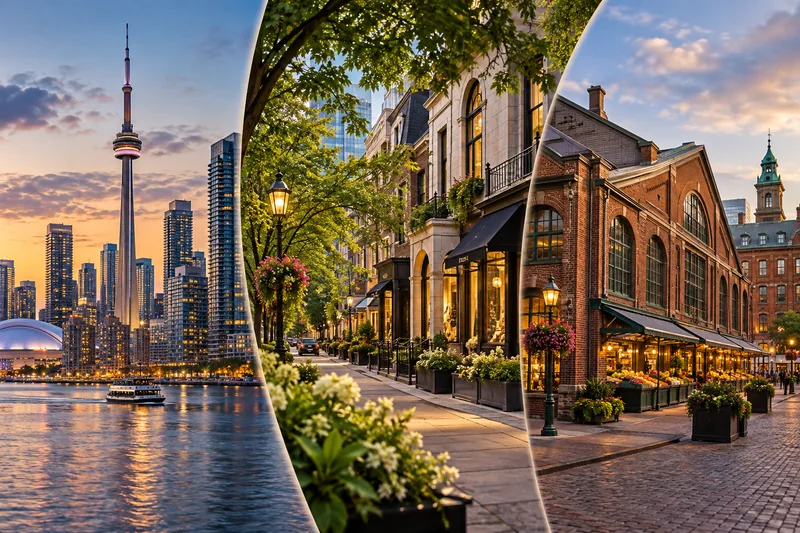
Entertainment District is JnA’s broad first-trip default when your priorities are split across the CN Tower / waterfront, sports or theatre, Union Station and central downtown.
Choose Yorkville when museums, Bloor shopping and a more polished north-central evening pattern matter most. Choose St. Lawrence when Old Town, food, Distillery / King East and the historic-east side of downtown are the trip’s repeated geography.
Yonge–Eaton is the general-purpose challenger when central shopping, Line 1 access and a broad hotel supply are more useful than the stronger neighbourhood identity of the three main options.
There is no numeric trip-duration threshold behind this guide. For most first-timers, one well-chosen hotel is enough.
In this guide
Compare the main areas
| Area | Strongest fit | What it reduces | Main trade-off |
|---|---|---|---|
| Entertainment District | CN Tower / waterfront, sports, theatre, Union-oriented trip | Repeated movement for major central / south-downtown priorities | Yorkville / museum trips and exact event-noise blocks still matter |
| Yorkville | ROM / Bloor, shopping, polished dining and evenings | Repeated north-central movement | More trips south to Union / waterfront |
| St. Lawrence | Old Town, market / food, Distillery and King East | Repeated east-downtown movement | Yorkville and west-side trips become less direct |
| Yonge–Eaton | Central shopping, Line 1, broad hotel choice | Balanced access without a strong specialist bias | Less distinct neighbourhood purpose |
Entertainment District: the broad default
Entertainment District works because several common first-trip priorities cluster around it: CN Tower / Ripley’s area, sports and theatre, waterfront access and Union Station.
That makes it a practical choice when the itinerary is mixed and you do not have a strong museum / Bloor or historic-east bias.
The exact block still matters. Event nights, street noise and the distance to the useful station or streetcar stop can differ materially within a neighbourhood label.
Yorkville: for museums, Bloor and polished evenings
Yorkville suits a trip where the ROM / Bloor side of Toronto is not a one-off visit but part of the daily routine.
It also fits travellers who value shopping, dining and a more polished evening base.
The trade-off is repeated southbound movement. If most of your sightseeing sits around Union, the waterfront and CN Tower area, a beautiful Yorkville hotel can still create an unnecessary commute.
Choose it when you want to return to Yorkville, not merely visit it once.
St. Lawrence: for Old Town, food and the east side
St. Lawrence fits a trip built around the market / food identity, Old Town, Distillery District and King East.
It can provide a different evening rhythm from the Entertainment District while remaining downtown.
The trade-off is the other side of the same decision: museum / Bloor priorities and some west-side plans may require more movement.
Yonge–Eaton: the general-purpose challenger
Yonge–Eaton is useful when you want a central, practical hotel search without a strong specialist neighbourhood priority.
It can work for central shopping, broad hotel choice and Line 1 access.
This is a challenger because it solves the “balanced central base” problem. It should not displace Entertainment District, Yorkville or St. Lawrence when one of those areas clearly matches the experiences you plan to repeat.
The area name is only the first filter
A Toronto stay decision should be tested at the hotel level.
Check:
- Exact pin: is the property actually where the neighbourhood label suggests?
- Repeated geography: which journeys will you make every day?
- Evening pattern: where do you want to be after dinner, theatre, sport or a long sightseeing day?
- Luggage: how awkward is the final trip from Union Station or your airport transfer?
- Winter / weather exposure: does the final walk still look reasonable when conditions are poor?
- Noise: is the actual block affected by event or nightlife activity you care about?
The airport or Union Station should refine the decision, not automatically overpower several days of repeated sightseeing geography.
One hotel usually wins
There is no fixed 3-night, 4-night or 5-night split threshold.
For most first-timers, the cost of changing Toronto hotels is not justified simply to be closer to a different neighbourhood for one day. Choose the base that removes the largest amount of repeated movement.
A hotel change would need a specific logistical reason to earn its disruption.
Your final decision
Choose Entertainment District for the broad first-trip default and south-downtown priorities. Choose Yorkville for museums, Bloor, shopping and north-central evenings. Choose St. Lawrence for Old Town, food and the historic east. Use Yonge–Eaton when balanced central practicality matters more than a specialised neighbourhood identity.
Then verify the exact hotel pin, repeated daily geography, evening routine and final luggage leg. The neighbourhood name alone is not the decision.