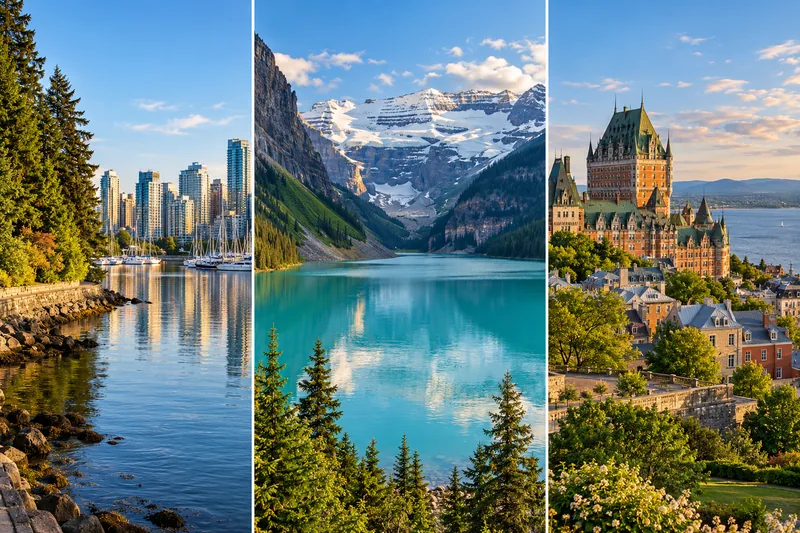
Choose the West Coast for a balanced city-and-nature trip, the Canadian Rockies when mountains are the main reason for travelling, or Eastern Cities for food, culture and a rail-led journey. Start with one region and make its transfers fit before adding another.
In this guide
Which region fits?
| Choose | Best fit | Main trade-off |
|---|---|---|
| West Coast | Vancouver city time with coastal scenery and an extension to Victoria or Whistler | The extension needs its own transfer allowance; car-light travel still takes planning |
| Canadian Rockies | Banff and Lake Louise when mountain scenery and outdoor time are the priority | Transport, seasonal access and weather shape the days more strongly |
| Eastern Cities | Toronto, Montréal and Québec City for neighbourhoods, food, history and architecture | Rail connects the regional route, but station transfers and hotel changes still use trip time |
The West Coast is the broad starting point for a mixed-interest group. Mountain-first travellers should favour the Rockies. For a multi-city trip without driving, start with Eastern Cities; the West Coast can also work with one carefully chosen extension. A car-light Rockies trip is possible, but build it around available transport to the places you actually want to visit.
Match the scope to your trip days
These are planning bands, not minimum-stay rules. Trip days include arrivals, departures and transfers; they are not a count of hotel nights or guaranteed full sightseeing days.
| Trip length | Starting structure |
|---|---|
| 6–7 days | One gateway plus one extension: Vancouver with Victoria or Whistler; a Banff/Lake Louise focus; or Toronto with Niagara or Montréal |
| 9–10 days | One region is the strongest default. Spend longer in the Rockies, deepen a West Coast pair, or consider Toronto–Montréal–Québec City |
| 12–14 days | Add depth and flexibility, or test one carefully planned second region only after its full transfer cost fits |
With under 10 days, keep one region. Around two weeks, one region in depth remains a complete trip. Crossing the country in one week is a poor starting plan for this kind of first visit.
Keep each region coherent
West Coast: Vancouver plus one extension can be enough. Victoria adds a harbour-and-coast focus; Whistler adds mountain time. Think 6 days for a compact pair, 8 days for a less compressed pair, or 10 days to consider all three at a more active pace. For a ferry-based Victoria transfer, count travel to the terminal, check-in, sailing and onward travel. Whistler also needs an intercity transfer allowance.
Rockies: Use Calgary as the gateway and keep a Banff/Lake Louise focus. A 6-day version stays compact; 8 days can buy slower outdoor days and weather flexibility. At 10 days, test a wider extension only after its route and access work for your dates; keeping the same core is still worthwhile. Confirm transport to the desired lake or activity before making it essential to the trip. More days do not guarantee access or clear weather.
Eastern Cities: A 7-day example pairs Toronto/Niagara with Montréal, leaving Québec City for another trip if adding it would squeeze the days. 10 days gives a starting framework for Toronto–Montréal–Québec City. At 12 days, add one extra: Ottawa, an overnight at Niagara, slower city time or arrival/departure flexibility. Keep Niagara attached to the Toronto part. The three-city eastern route is one region, not a two-region combination.
When a second region makes sense
At 12–14 days, Vancouver plus the Rockies is a conditional option if both experiences matter and the connection leaves enough time in each. A longer overland journey needs its own allowance. A distant second region adds a major transfer; decide how it works before counting the extra destination as sightseeing time.
For families or slower travellers, fewer hotel changes and one flexible day may be more valuable than another region. Choose the experiences the group wants to repeat, not the longest destination list.
Let the season change the plan
Check the season against your chosen experience. In the Rockies, mountain weather can change quickly, high trails can retain snow beyond the valley season, and winter brings shorter daylight. A summer-style outdoor plan should not be copied unchanged into another season. Keep the core useful even if one activity cannot happen.
Once Toronto is part of the route, use the Toronto stay guide to choose the hotel area.