Use this guide after choosing your Korea route. For each move, start with the departure and arrival cities, the exact hotels, your travel date, bags and group needs. The question is how to make that journey work.
In this guide
Start with the mode that fits the segment
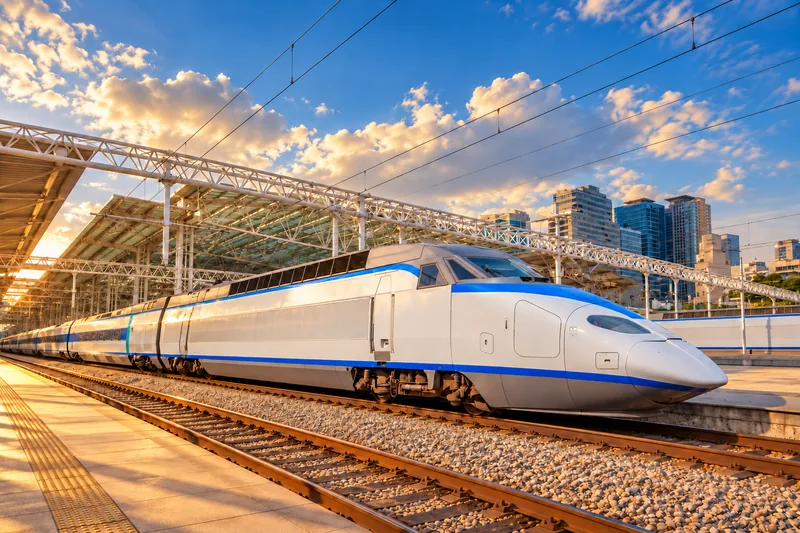
Check KTX or high-speed rail first for a useful direct mainland connection. Check a domestic flight first for Jeju. Check express or intercity bus when practical rail is absent or a direct bus removes awkward transfers. Then compare the complete hotel-to-hotel journey.
| First check | When it fits | What can reverse it |
|---|---|---|
| KTX / high-speed rail | A direct mainland service with practical stations at both ends; Seoul–Busan is the classic example | Difficult station access, an inconvenient arrival station, or a rival with a better complete journey |
| Domestic flight | Jeju or another segment where air genuinely solves the geography | Airport access, check-in, baggage and the final transfer consume the apparent time saving |
| Express / intercity bus | One direct ride reaches the right terminal or avoids a rail interchange | Road congestion, an awkward terminal or a long seated journey outweighs the simpler connection |
Conventional rail is worth a second look. If KTX is indirect or poorly placed, a direct conventional train may trade a slower ride for fewer changes or a more useful stop. Compare it before defaulting to bus.
Compare seven parts of the journey
Put each realistic option through the same test:
- Hotel to departure point: the exact station, airport or bus terminal, including walking with bags.
- Early-arrival buffer: enough time for the service and your group.
- Check-in and security: where applicable, including bag drop.
- Boarding and waiting: the departure you can actually catch.
- The main journey: direct service or connections, with road-delay exposure where relevant.
- Arrival and interchange: getting off, collecting luggage and reaching any onward service.
- The last mile: the walk, bus or taxi to your hotel entrance.
Avoid counting the same buffer twice. Compare elapsed time alongside cost, changes and physical effort. A short flight is only one part of an airport journey; a fast train ends at a station, not at your hotel.
Let the last mile challenge the default
For Seoul–Busan, rail is a strong starting comparison when the stations suit both hotels. A flight becomes more interesting if your actual bases are unusually airport-convenient, its timing connects naturally with another flight, or the full cost and schedule offer a real advantage.
For Seoul–Gyeongju, compare the onward journey from the KTX station with the journey from the bus terminal to your particular hotel. The quicker intercity ride need not give the easier arrival. That is a reason to check the last mile, not a rule that bus wins.
For Jeju, keep the airport-to-base journey in the flight comparison. Reaching the island and reaching your accommodation are separate steps.
For Seoul–Sokcho, test the direct bus option against the practical rail-and-onward alternatives available for your date. Confirm the exact terminals at both ends. These are separate examples, not a suggested four-stop itinerary.
What else can change the answer?
- Bags, children and mixed energy: fewer changes can matter more than a shorter main ride. Check walking, boarding and luggage handling for the whole group.
- Mobility needs: check the actual station or terminal route and required assistance; a direct service alone does not establish an accessible journey.
- Peak dates: holiday demand can limit seats, while busy roads can weaken the bus option. Check reservation arrangements early when your dates are fixed, and keep a workable alternative.
- The real total cost: include access and onward travel, plus any baggage charges that apply to the selected fare. No mode is always cheapest.
Before paying, confirm the exact departure and arrival points, directness, baggage conditions and whether the final local connection works at your arrival time. Recheck service conditions before travelling.
Choose each segment independently. A Korea trip can sensibly combine rail, flight and bus. If every workable transfer consumes too much of the trip, return to the upstream question of whether the extra city belongs before optimising its transport.